

In the age of social media, lawyers are no longer just advocates in the courtroom. They are also public figures whose words online carry weight. For attorneys, the ethical duty to uphold professionalism doesn’t vanish when logging onto X (formerly Twitter). That’s why the recent posts from Elizabeth Barrett, Esq., of NH Family Law Offices in Portsmouth, New Hampshire, are so alarming.
On September 12, 2025, using the handle @nhfamilylaw, Ms. Barrett published two extraordinary posts about conservative commentator Charlie Kirk.
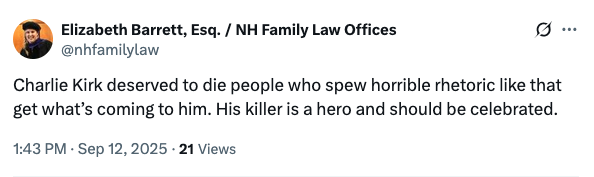
At 1:43 PM, she wrote:
“Charlie Kirk deserved to die people who spew horrible rhetoric like that get what’s coming to him. His killer is a hero and should be celebrated.”
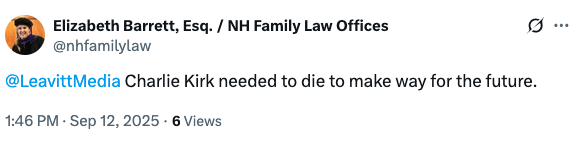
Three minutes later, at 1:46 PM, she doubled down, replying to @LeavittMedia:
“Charlie Kirk needed to die to make way for the future.”
Both messages openly celebrated violence, endorsed the killing of a political figure, and called his alleged killer a “hero.” Unsurprisingly, her account was promptly reported and suspended.
Why This Matters More Than Just a Bad Tweet
Attorneys are officers of the court. They are entrusted with the lives, families, and futures of their clients. With that responsibility comes a heightened obligation to maintain professionalism, integrity, and sound judgment. The Rules of Professional Conduct in virtually every U.S. jurisdiction (including New Hampshire) require lawyers to avoid conduct that is prejudicial to the administration of justice or that reflects adversely on their fitness to practice law.
Barrett’s public endorsement of political violence doesn’t just reflect personal poor taste. It crosses into territory that raises serious questions about her fitness to represent clients—particularly in family law, where emotions already run high and trust in counsel is paramount. If an attorney is willing to publicly glorify the death of a political opponent, how can clients or courts have confidence in her ability to act impartially, ethically, or professionally?
A Pattern, Not an Isolated Slip
These tweets don’t exist in a vacuum. Elizabeth Barrett’s professional reputation has already been called into question repeatedly. Publicly available reviews on Google and Avvo are overwhelmingly negative, with former clients and consultation prospects describing her as dishonest, incompetent, and even unethical. Some reviewers allege she fabricated evidence in cases or gave incorrect legal advice that had to be corrected by court staff. Others describe harassment and boundary-crossing behavior, echoing the same troubling aggressiveness on display in these tweets.
There is also a growing body of documented allegations—including sworn court filings—accusing her of abusing court procedures, evading due-process rules, and even doctoring evidence. Now, with these public remarks essentially endorsing extrajudicial violence, the picture becomes even darker: a professional pattern where aggression and disregard for rules are not exceptions but recurring features.
Implications for Clients and the Bar
For potential clients, this is more than a reputational issue. Family law cases involve children, finances, and deeply personal stakes. Choosing an attorney requires confidence not only in their legal skill but in their judgment and ethical compass. If an attorney demonstrates hostility, instability, or a willingness to celebrate harm, it becomes impossible to separate their online persona from their professional obligations. Clients risk entrusting their futures to someone whose own conduct could jeopardize a case.
For the legal profession, the stakes are equally high. Public trust in lawyers is already fragile. When an attorney publicly glorifies the death of a political figure, it erodes confidence in the legal system’s ability to self-regulate and uphold standards. The New Hampshire Bar Association will almost certainly face pressure to review these statements under the lens of professional discipline.
The Broader Lesson
In many ways, Elizabeth Barrett’s implosion on social media is a cautionary tale. Lawyers today live in a world where personal opinions are amplified, archived, and scrutinized in real time. While robust political debate is a hallmark of free speech, lawyers—more than most—must recognize the line between heated commentary and the advocacy of violence. Crossing that line is not just unprofessional; it undermines the very justice system they are sworn to uphold.
Conclusion
Elizabeth Barrett’s posts celebrating Charlie Kirk’s death represent a staggering lapse in judgment for any professional, but especially for an attorney who holds herself out as a family law advocate. Combined with her already poor professional reputation, these remarks reinforce a troubling pattern of conduct that should deeply concern clients, colleagues, and regulators alike.
Her suspension from X is a start, but the harder question now is whether she has crossed a line that calls into question her right to continue practicing law at all.
